

Why values in the body change
And why this is often completely misunderstood
A phenomenon familiar to many
Many people experience the following:
- Two measurements taken a few days apart show different results
- Blood values seem to change for no clear reason
- Results do not match your own body image
And often the same question arises:
How can that be?
The classic misunderstanding
This is often assumed:
👉 A value shows how much is present in the body.
This automatically leads to this conclusion:
- high value = good
- low value = deficiency
But this view often falls short.
What actually happens
The body does not work statically –
but as a dynamic system.
Nutrients are not only stored,
but also used in different ways depending on requirements.
👉 That means:
- demand increases → usage increases → values can fall
- demand decreases → usage decreases → values can increase
Use instead of stock
A measured value not only shows what is present –
but also how intensively the body is currently using this substance.
👉 Therefore, a low value can mean two things:
- Actual defect
- or increased activity in the system
👉 Without context, these two situations are almost indistinguishable.
Why changes often occur very quickly
Our practical observations show:
👉 Values can sometimes change very quickly –
even within 24 hours.
This occurs in particular when the body:
- Metabolic processes activated
- Processes reorganized
- Shifts priorities in the system
👉 The body does not react linearly,
but dynamically and depending on the situation.
The body does not work in a straight line,
but in overlapping processes.
While a main process is active,
other processes can be interposed at the same time.
This dynamic means that values can fluctuate in the short term –
although the system is stable overall.
Example values from our internal measurement series
The following examples show real, anonymized historical data of a person for essential building blocks with daily measurement.
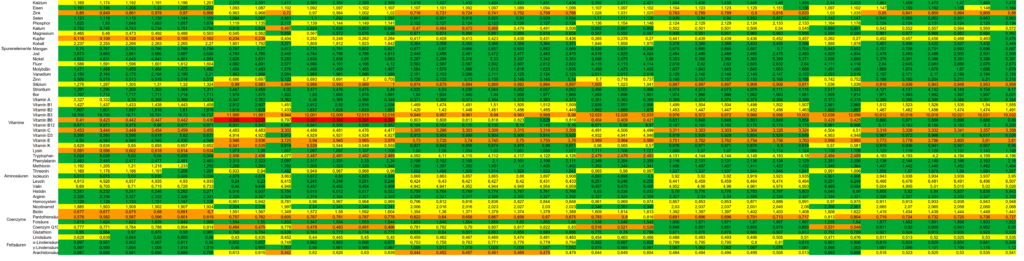
At first glance, this presentation appears complex.
The decisive factor, however, is the underlying pattern:
👉 Values do not change randomly,
but follow dynamic processes in the body.
👉 Important:
Despite fluctuations, it is clear
that these changes are part of overarching main processes,
which alternate and influence each other.
👉 It is precisely this interaction that we will explain step by step on the following pages
using specific examples.
What does this mean for the valuation?
A single value can easily be misinterpreted.
👉 It only becomes understandable in context:
- time course
- Current status
- Overall context
This is exactly where the next level comes in
If the body works dynamically,
the analysis must also make this dynamic visible.
👉 The crucial question is therefore:
What phase is the body currently in?
Continuing:
Would you like to understand how your body is currently working?
Our analysis not only shows individual values –
but also the current state of your body.

© 2026 UNISON.health
The dynamic deployment model shown and the UNISON.health body phase logic are the intellectual property of UNISON.health.
Use, reproduction or distribution – even in part – only with written permission.